Voice of Wisdom
Framework
Four capacities that help technical expertise shape decisions when it matters.
Communication is not one skill.
A scientist may have a strong recommendation but bury it in caveats. An engineer may explain the work accurately but not in a way a decision-maker can use. A physician may know exactly what needs to be said, yet find that speech, pacing, or vocal tension make the message harder to receive.
People experience communication from the outside in. They notice posture, eye contact, voice, pace, and word choice before they have fully assessed the idea. That is why feedback so often targets the visible layer: speak up, slow down, make more eye contact, sound more confident.
But the visible behavior is not always where the problem begins. An unclear position affects how a message is framed. The framing affects delivery. Delivery affects how presence is read.
The Voice of Wisdom Framework helps identify the layer creating the friction, rather than correcting only the symptom people can see. It brings four capacities into view: ALIGN, ADAPT, ARTICULATE, and AMPLIFY.
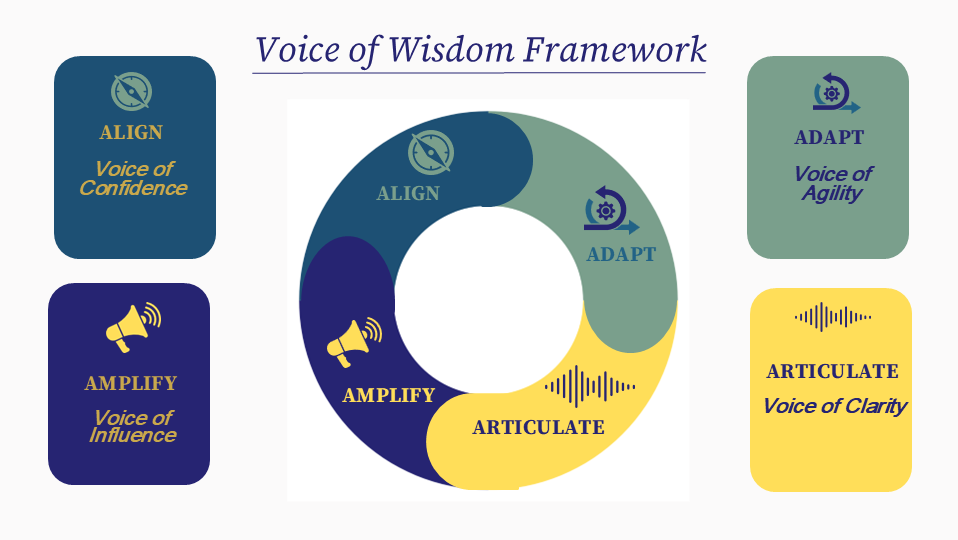

ALIGN
Voice of Confidence
Without it: In important meetings, the recommendation gets buried beneath caveats, background, and the need to prove you have considered everything.
With it: You can state what you recommend, explain why, and stay with your position when someone challenges it.
You'll be able to:
- Lead with your point instead of circling toward it
- Answer a difficult question without immediately backtracking
- Separate useful nuance from the urge to over-explain
ADAPT
Voice of Agility
Without it: The same explanation is used for a technical peer, an executive, and a funder—and the listener leaves unclear about why the work matters.
With it: You can help each audience understand the significance of the work and what they need to do next.
You'll be able to:
- Decide what to lead with for a funder, executive, collaborator, or technical peer
- Turn a complex explanation into a message people outside the field can follow
- Notice when a listener is lost and adjust before the conversation moves on
ARTICULATE
Voice of Clarity
Without it: Listeners have to work to follow the words, emphasis, or pace of the message, especially when the conversation becomes spontaneous or high-stakes.
With it: Your speech and delivery make the important idea easier to hear, follow, and remember.
You'll be able to:
- Make key words and distinctions clear enough that listeners do not miss them
- Slow down, emphasize, or pause where the message needs it
- Answer questions without losing clarity or making listeners work harder
AMPLIFY
Voice of Influence
Without it: Even when the content is strong, your contribution can disappear in a large room, a tense discussion, or a higher-level conversation.
With it: Your presence helps the room recognize when you are making a point worth considering.
You'll be able to:
- Enter a room or virtual meeting with a clear, visible point of view
- Use voice, posture, eye contact, and gesture to support—not compete with—your message
- Hold attention when presenting a recommendation, answering scrutiny, or facilitating a decision
Find the Real Issue Beneath the Visible One
The four capacities are diagnostic before they are developmental.
The first question is not, “How can this person appear more confident?” It is: What is getting in the way of the message?
Someone who seems hesitant with executives may not have a delivery problem. They may not yet know what they recommend. Someone whose ideas are consistently misunderstood may not lack expertise. Their explanation may not yet match the audience.
The Voice of Wisdom Framework helps identify what is beneath the visible problem, then build the capacity to address it.
It informs executive coaching, organizational engagements, and Voice of Wisdom Intensives.
The framework stays the same; the entry point changes.
See Which Capacity Needs Attention
The Clarity & Confidence Scorecard helps identify where your communication already carries authority and where friction may be limiting clarity, influence, or listener ease.
Get the Scorecard